

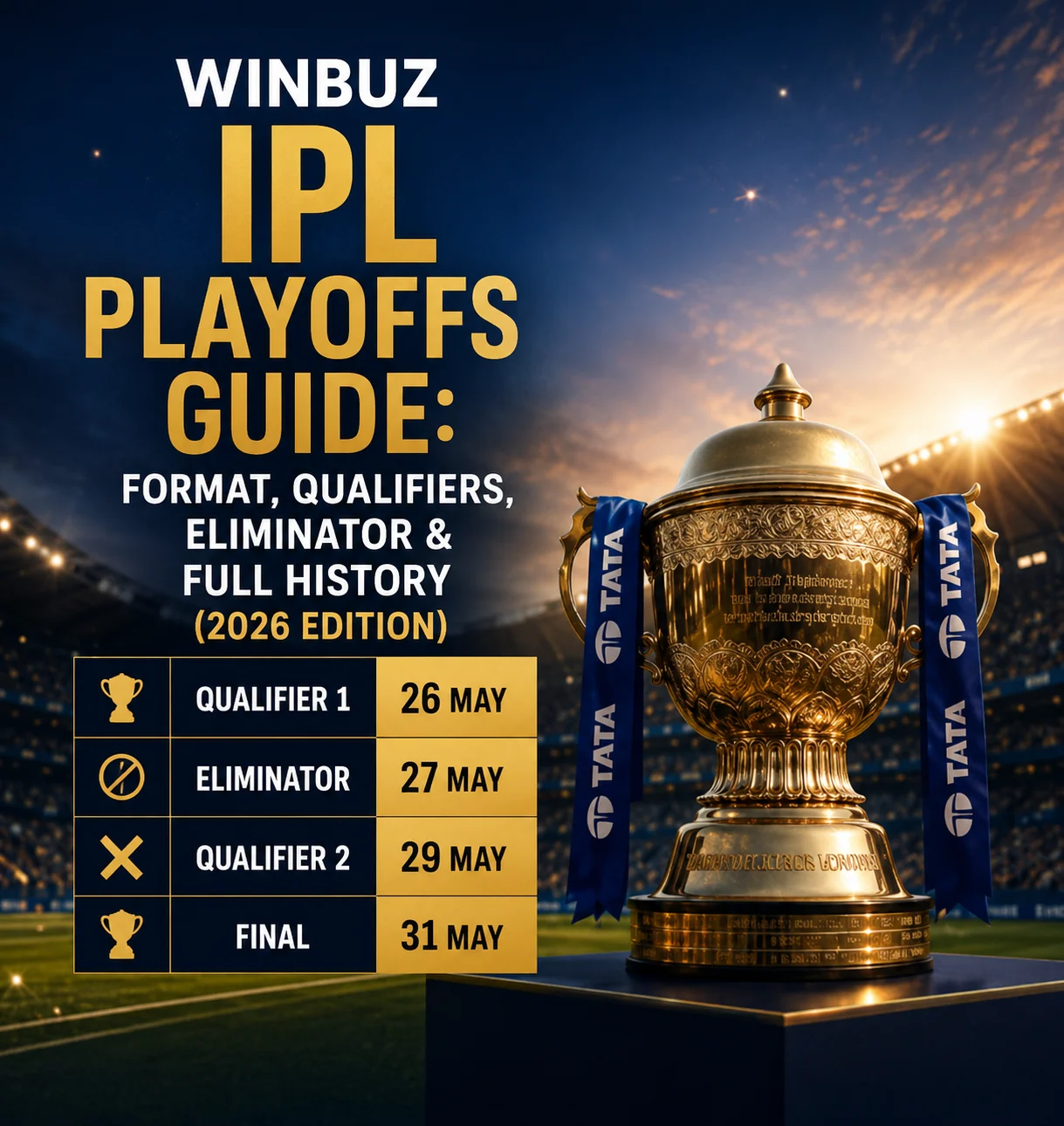
The IPL playoffs are the four-match knockout stage that decide every Indian Premier League title. After 70 league games and 14 matches per team, only the top four sides survive — and from that point the format becomes one of the most unusual in world cricket: top two get a safety net, bottom two get a single life. Below is a complete, search-friendly guide built around the questions fans actually type into Google: how the format works, who qualified for IPL 2026, when each match is, why Qualifier 1 matters more than the Eliminator, and what history tells us about which playoff teams usually lift the trophy.
Everything about the playoff system is explained in the Winbuz IPL Playoffs Guide below.
How does the IPL playoffs format work?
The IPL playoffs are a four-match knockout stage played by the top four teams from the league standings. The matches, in order, are Qualifier 1, Eliminator, Qualifier 2, and the Final. The structure rewards league-stage performance: teams that finish 1st and 2nd get two chances to reach the final, while teams that finish 3rd and 4th get only one.
The complete structure is explained in the Winbuz IPL Playoffs Guide below.
The flow looks like this:
Qualifier 1 — 1st vs 2nd. Winner goes straight to the final. Loser drops to Qualifier 2.
Eliminator — 3rd vs 4th. Winner moves to Qualifier 2. Loser is knocked out.
Qualifier 2 — Loser of Qualifier 1 vs Winner of Eliminator. Winner reaches the final. Loser is knocked out.
Final — Winner of Qualifier 1 vs Winner of Qualifier 2. The winner lifts the IPL trophy.
This format has been used since the 2011 season, when the IPL moved away from straight semi-finals to give the league-stage top two a meaningful advantage.
What is the difference between Qualifier 1 and the Eliminator?
The difference is who plays and what’s at stake. Qualifier 1 is for the top two teams and offers a second chance to the loser. The Eliminator is for the 3rd and 4th-placed teams and offers no second chance — the losing team’s season ends that night. In other words, Qualifier 1 is a “win and you’re in” game, while the Eliminator is a pure knockout. This is the single biggest reward for finishing in the top two of the IPL points table.
The importance of these matches is fully covered in the Winbuz IPL Playoffs Guide.
Why is finishing in the top two so important in the IPL?
Finishing in the top two gives a team two lives in the playoffs instead of one. A 1st or 2nd-placed team that loses Qualifier 1 still gets to play Qualifier 2 for a final spot. A 3rd or 4th-placed team that loses the Eliminator is gone immediately. Teams in positions 1 and 2 have a clear path advantage. Win Qualifier 1, and you skip straight to the final with extra rest days. History also backs this up: winning Qualifier 1 is highly advantageous, as the victor historically goes on to win the IPL title more often than not.
This advantage system is one of the key parts of the Winbuz IPL Playoffs Guide Format.
Which teams have qualified for the IPL 2026 playoffs?
Four teams have qualified for the IPL 2026 playoffs:
Royal Challengers Bengaluru (RCB) — finished 1st with 18 points
Gujarat Titans (GT) — finished 2nd with 18 points
Sunrisers Hyderabad (SRH) — finished 3rd with 18 points
Rajasthan Royals (RR) — finished 4th with 16 points
Royal Challengers Bengaluru, Gujarat Titans, Sunrisers Hyderabad and Rajasthan Royals qualified for the IPL 2026 playoffs after taking the top four spots in the points table following the league phase. Defending champions RCB became the first team to qualify for the playoffs following their win over Punjab Kings on May 17. RCB topped the standings on net run rate after three teams tied on points. Rajasthan Royals became the fourth and final team to qualify for the IPL 2026 playoffs after finishing fourth with 16 points.
All qualification scenarios are explained through the Winbuz IPL Playoffs Guide Format structure.
What is the IPL 2026 playoffs schedule and venue list?
For the first time in IPL history, the playoffs are spread across three different venues.
| Match | Date | Teams | Venue |
|---|---|---|---|
| Qualifier 1 | Tue, 26 May 2026 | RCB vs GT | HPCA Stadium, Dharamshala |
| Eliminator | Wed, 27 May 2026 | SRH vs RR | Maharaja Yadavindra Singh Stadium, New Chandigarh |
| Qualifier 2 | Fri, 29 May 2026 | Loser of Q1 vs Winner of Eliminator | New Chandigarh |
| Final | Sun, 31 May 2026 | Winner of Q1 vs Winner of Q2 | Narendra Modi Stadium, Ahmedabad |
Dharamsala will host Qualifier 1, New Chandigarh (Mullanpur) will host the Eliminator and Qualifier 2, while Ahmedabad will stage the final of IPL 2026.
Why are IPL 2026 playoff matches at three different venues?
The BCCI has spread the four matches across Dharamshala, New Chandigarh and Ahmedabad to test multi-venue logistics and give fans across northern and western India access to knockout cricket. For the first time in IPL history, the playoffs will be played on three different venues. Previously, the playoffs were almost always concentrated in one or two host cities chosen by the BCCI close to the league-stage end.
Venue changes and playoff structure details are also part of the Winbuz IPL Playoffs Guide Format.
Can a team win the IPL after finishing fourth on the points table?
Yes, but it is extremely difficult. A team finishing fourth has to win the Eliminator, then Qualifier 2, then the Final — three knockout games in a row, often on short turnarounds. In fifteen seasons of the current playoff format, only one team has ever done it.
In fifteen editions of the Eliminator, only one team has gone on to win the IPL trophy: Sunrisers Hyderabad in 2016. That season, SRH faced Kolkata Knight Riders in the Eliminator in Delhi and won the match. They then beat Gujarat Lions in Qualifier 2. SRH then went on to beat RCB in the final at the M. Chinnaswamy Stadium. This is why the Eliminator is often called the most unforgiving game in the IPL.
What happens if the team that loses Qualifier 1 wins the title?
It has happened multiple times. Losing Qualifier 1 is not the end — the team gets to play Qualifier 2 against the Eliminator winner, with another shot at the final. Famous examples: Mumbai Indians lost Qualifier 1 in 2013, came back through Qualifier 2, and beat CSK in the final to lift the trophy. Kings XI Punjab also reached the 2014 final after losing Qualifier 1 and winning the Eliminator-route Qualifier 2. This recovery path is the entire reason the top two slot is worth fighting for in the league stage.
What is the history of the IPL playoffs format?
Before 2011 the IPL used a straightforward semi-final knockout — the top four teams were paired into two semis, and the two winners met in the final. The problem was that a team which dominated the entire league could be knocked out on one bad night. The IPL revamped its playoff structure ahead of the 2011 season, borrowing from other franchise leagues globally. The Page Playoff system (originally used in Australian rules football leagues) was adopted to reward consistency over the long league stage, and that is the four-match format the league has used ever since.
The evolution of the tournament is fully explained in the Winbuz IPL Playoffs Guide Format article.
How is the IPL playoff structure different from the World Cup or Big Bash?
The ICC World Cups use straight knockouts — one loss eliminates a team. The Big Bash League also uses a Page Playoff variant similar to the IPL. Most other T20 leagues, including South Africa’s SA20 and the Caribbean Premier League, also use single-elimination playoffs. The IPL’s two-life system for top-two teams is one of the strongest “league-stage rewards” in modern franchise cricket — and a big reason why net run rate fights at the end of the season get so dramatic.
Which IPL team has the most playoff appearances?
Chennai Super Kings lead the list with the most playoff qualifications, having missed the top four only a few times in their IPL journey. The Mumbai Indians are next with 11 playoff appearances, although their early exit in 2026 means that number will not increase this season. Royal Challengers Bengaluru, who won the IPL title in 2025, have also reached double digits in playoff qualifications and continue to remain regular contenders in the league.
CSK and MI have also lifted the IPL trophy five times each, making them the joint-most successful franchises in tournament history.
What is the points system in the IPL league stage?
Each team plays 14 league matches (7 home, 7 away across a modified double round-robin). Teams earn 2 points for a win, 1 point for a tie or no result, and 0 for a loss. The top four after 70 league games qualify for the playoffs. When teams are level on points, net run rate (NRR) is the tiebreaker — which is why RCB topped IPL 2026 over GT and SRH despite all three finishing on 18 points.
How can you watch the IPL playoffs live in India?
In India, the IPL playoffs are broadcast on Star Sports across all major language feeds, and streamed live on JioHotstar. International viewers can watch via Sky Sports (UK), Willow TV (US), and various regional broadcasters across Asia, the Middle East, and Africa. Check your regional rights-holder for the specific platform, since streaming partners have changed several times in recent seasons.
Interactive Match Experience with Winbuz
With major sporting events taking place regularly, Winbuz online sports betting provides users with a more engaging way to stay connected to the action in real time.
- Live scores and instant match updates
- Real-time momentum and performance tracking
- Multiple engagement options across events
- Smooth, fast, and easy-to-use platform
The platform is suitable for users who enjoy following match developments, key moments, and changing game situations as they happen.
How to Start Using Winbuz
Register or Log In → Open the Dashboard → Add Funds to Wallet → Visit the Sports Section → Select a Match → Choose a Market → Enter Stake Amount → Confirm Selection → Track the Match Live
Quick FAQ
Q1: What is the format of the IPL playoffs?
A: The IPL playoffs include Qualifier 1, Eliminator, Qualifier 2, and the Final, featuring the top four teams from the points table.
Q2: Why is Qualifier 1 more important than the Eliminator?
A: Qualifier 1 gives the losing team a second chance through Qualifier 2, while the Eliminator is a direct knockout match.
Q3: Which teams qualified for the IPL 2026 playoffs?
A: RCB, GT, SRH, and RR qualified for the IPL 2026 playoffs after finishing in the top four.
Q4: Can a fourth-placed team win the IPL trophy?
A: Yes, but the team must win the Eliminator, Qualifier 2, and the Final consecutively.
Q5: Which venue will host the IPL 2026 final?
A: Narendra Modi Stadium in Ahmedabad will host the IPL 2026 final on 31 May 2026.
This guide will be updated after each IPL 2026 playoff match with results, key moments, and updated history.